In Part 1, we talked about the founder who signed a contract for an enterprise-grade security platform and three months later realized she wasn’t using a quarter of it. I want to go back to her for a second, because her mistake wasn’t that she cared too much about security. It’s that she bought a playbook that was never written for her.
The standard playbook wasn’t built for you
Most cybersecurity advice — the frameworks, the vendor pitches, the “best practices” checklists — comes from enterprise security. And enterprise security exists to answer a very different question than the one you’re asking.
An enterprise with a dedicated security team is protecting thousands of endpoints, a sprawling vendor network, regulatory obligations across multiple jurisdictions, and a brand that makes headlines if it’s breached. Their security budget reflects all of that. Six and seven figures a year isn’t overkill for them — it’s proportional to what they’re protecting.
That’s the playbook that gets sold down-market to small businesses, sometimes with the logo swapped and the price cut in half. But cutting an enterprise budget in half doesn’t make it a small business budget — it just makes it an enterprise budget you can’t fully use. Same platform, same complexity, same learning curve. You just paid less for the parts you were never going to touch.
That’s why the standard playbook doesn’t work for small businesses. It’s not wrong. It’s just answering someone else’s question — which is exactly why you need a small business cybersecurity plan built around your own answer.
The right question: what does your business actually need?
Here’s where we bring it back to the framework from Part 1: spend to the size of the risk. But to do that, you have to actually know your risk — and your risk isn’t determined by your revenue or your industry buzzword. It’s determined by how your business actually operates.

Three questions get you most of the way there:
Who’s touching your systems, and from where? A fully remote or hybrid team means your risk isn’t contained to one office with one network. Every laptop, every home wifi router, every coffee shop login is a potential entry point. If your team logs in from five different cities, your biggest exposure might not be a hacker — it might be an employee on public wifi with no idea they’re a target.
Who else has access to your data? Vendors, contractors, freelancers, that app you connected to your CRM two years ago and forgot about — every third party with access to your systems is a door you don’t fully control. Small businesses often have more vendor sprawl than they realize, because it’s easy to add a tool and hard to remember to remove it.
Does money move through your systems? If you’re processing payments, invoicing clients, or handling payroll digitally, you’re not just protecting data — you’re protecting a direct line to cash. That changes your risk profile immediately, because it changes what an attacker stands to gain.
Answer those three honestly, and you’ll usually find your real risk concentrated in one or two places — not spread evenly across every threat a Fortune 500 company worries about. That’s the whole point: your security spending should follow your actual exposure, not a generic checklist built for a business ten times your size.
Small, specific, and yours

This is the shift we help founders make: away from “what’s the most secure thing I can buy” and toward “what does my business, with my team, my vendors, and my money flow, actually need protected first.”
I was recently sitting in a Mood Party, talking through what our business would look like if it were a storefront. As I was getting ready to share, the host said mine would be all dark and dreary. I laughed and said quite the opposite. If our business were a storefront, it would be a place clients could come in, sit down, and have a cup of coffee. We want you to feel at home so we can talk through the right solution for you. There is no one-size-fits-all solution for cybersecurity — especially for small business.
Your business is unique, and so is your security profile. We’re not going to hand you the same plan as everyone else, and we don’t want you thinking you need the same setup as everyone else. At the same time, every business owner needs to be thinking about cybersecurity at some level. A real small business cybersecurity plan starts with your risk, not someone else’s checklist.
That’s not a smaller version of enterprise security. It’s a different question entirely — and it’s the one that actually protects you.
Not sure what your answer is?
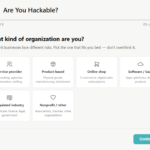
That’s exactly what the Security Self-Assessment is for — and it’s free. Let’s find out where your real exposure is, not where a generic playbook assumes it is.